Main Menu
One-time Payment
189.00 € (incl. VAT)
One-time Payment

Live sessions

Max. seats
Exhibitions often rely on unsustainable materials, energy-intensive logistics, and short-term production cycles, yet exhibition-makers rarely have the training to address these challenges. This course equips art professionals with the skills to plan and produce environmentally sustainable exhibitions. From reducing carbon emissions to applying circular design principles, you will learn how to align curatorial goals with climate responsibility.
Through critical discussion, interactive exercises, and hands-on assignments, you will discover how to:
Over five weeks, you will apply proven tools and best practices to an artwork or installation of your choice (real or imagined), using it as a case study to test sustainable decision-making in context. By the end of this course, you’ll have the resources and confidence to champion holistic sustainability in your curatorial practice and institutional contexts.
This course is designed for visual art practitioners (independent curators, museum and gallery staff, art handlers and technicians) involved in any aspect of exhibition-making and already have some familiarity with its general processes.
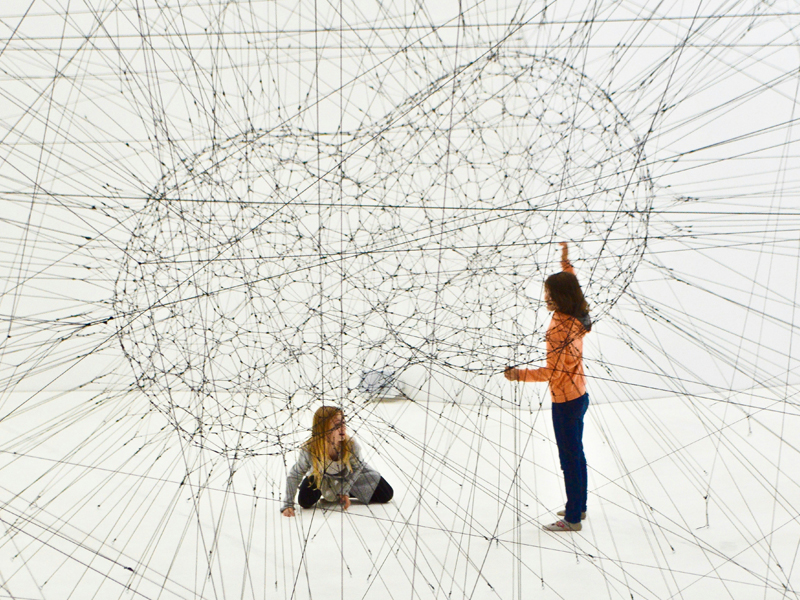
Image credits: Qihai Weng via Unsplash

Session 1: Introduction Session
This one-hour session serves as an introduction to the instructor, participants, and the course overall. You will select an artwork or installation to serve as your case study for the course.
Session 2: Choosing Sustainable Exhibition Materials
In Session 2, you will learn to procure exhibition materials based on sustainability principles.
We will cover:
Session 3: Measuring the Socio-Environmental Impact of Exhibitions
In this Session, you will learn to work with sustainability metrics and digital tools (such as carbon calculators) to assess the socio-environmental impact at different stages and sources of the exhibition process.
We will cover:
Session 4: Implementing Sustainable Principles in an Exhibition’s Life Cycle
In Session 4, you will practice embedding circular principles in exhibitions and discover further strategies to lower environmental impact across planning, transportation, installation, and deinstallation.
We will cover:
Session 5: Communicating Sustainability
In the final Session, we will focus on how to credibly communicate sustainability goals in funding proposals, institutional policies, and collaborations.
We will cover:
Language
Classes are held in English.
Format & Modality
The course is fully online and taught live via Zoom in small, interactive groups to support active learning. Live captioning is available during the sessions.
Schedule
Live sessions take place every (Day) from (Time) (Berlin time, CEST).
Attendance
Live attendance is encouraged to get the most out of the course, but recordings are available if you cannot attend a session.
Course Materials
All course materials—including recordings, readings, and presentations—are available on the Node platform for as long as you wish.
Assignments
Optional assignments are included, with personal feedback from the lecturers to help you apply what you learn. Please note that feedback is provided only during the course dates.
Certificate
A downloadable certificate is available upon course completion.
Technical Requirements
A stable internet connection, a computer with a camera and microphone, and access to Zoom are required.
Questions?
Check our FAQ or contact us via our online form.
Kim Kraczon