Main Menu
Duration
Feb. 09 - Mar. 16, 2026
Duration

Enroll before

One-time Payment

Live sessions

Max. seats
*This course offers University credits. To opt for credits read this page
This course gives insights into all practical aspects of curating from finalising a concept to launching an exhibition. Curators can have very different working approaches, but certain practical aspects will be the same and should be kept in mind for developing a successful project.
Over 6 weeks we will go through the major steps of curating, starting with how you develop an idea to finding collaborators, funding and an exhibition space; managing practical aspects such as transport, insurance and install; thinking about PR strategies and gaining audiences; to finally closing the project with deinstall. This course is for aspiring curators who are yet to launch their own exhibition as well as those who have past experience and are looking for a more structured understanding of curating.
At the end of A Practical Guide to Curating, participants should have an understanding of the skills necessary to operate as competent and responsible practitioners. Come with an already existing project idea or start from a blank page. Throughout the course you will develop a concrete outline of how to realise your exhibition.
*Prices include VAT
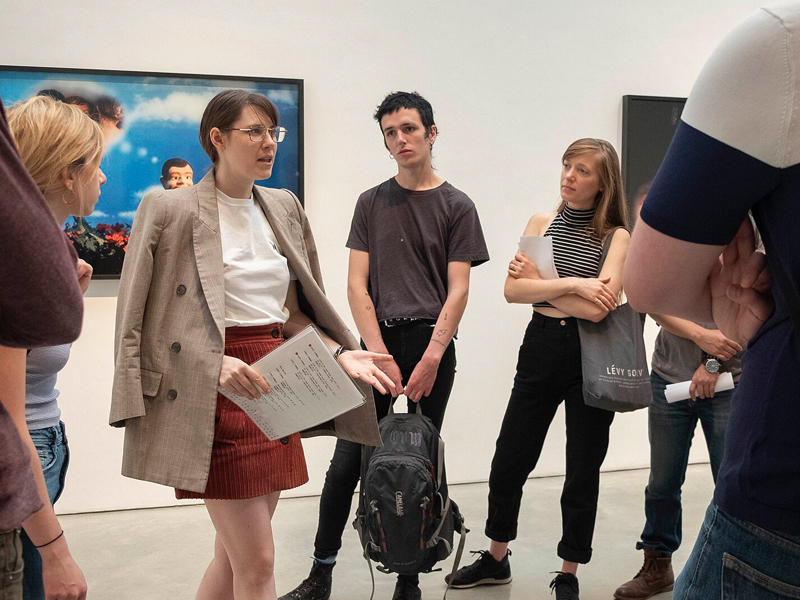
Image credit: Arts Practicum, CC BY-SA 2.0, via Wikimedia Commons

Session 1. Introduction
This is a one-hour-only welcome session. The lecturer will introduce the program and participants will introduce themselves. No prior preparation is necessary.
Session 2. Developing Your Curatorial Concept
Session 3. Exhibition-Making I - Artists, Collaborators, and Practical Skills
Session 4. Exhibition-Making II - Finances & Funding; Install & Time management.
Session 5. Displaying Artworks, Scenography, Narration
Session 6. Communication
Language
Classes are held in English.
Format & Modality
The course is fully online and taught live via Zoom in small, interactive groups to support active learning. Live captioning is available during the sessions.
Schedule
Live sessions take place every Monday from 1pm to 3pm (Berlin time, CEST).
Attendance
Live attendance is encouraged to get the most out of the course, but recordings are available if you cannot attend a session.
Course Materials
All course materials—including recordings, readings, and presentations—are available on the Node platform for as long as you wish.
Assignments
Optional assignments are included, with personal feedback from the lecturers to help you apply what you learn. Please note that feedback is provided only during the course dates.
Certificate
A downloadable certificate is available upon course completion.
Technical Requirements
A stable internet connection, a computer with a camera and microphone, and access to Zoom are required.
Questions?
Check our FAQ or contact us via our online form.
Nora Mayr
"It strengthened my practical skills. Now I know all the steps in creating and organising an exhibition. I am going to follow the elaborated scheme during work on my own exhibition."
"Professional lecturer, interesting materials each lecture. I really enjoyed getting a set of useful articles, presentation and materials after each session and the fact that the video recordings are available even after the course is amazing."
"I felt that I could immediately apply the things I learned during the lessons. Mostly because Nora's very practical approach to teaching - showing how things are done through relevant real-life examples"
"The course was very focussed on practicalities and rich in details. There were lots of helpful hints and the coverage was broad. Nora is clearly very experienced and presented material in a logical and structured way."